
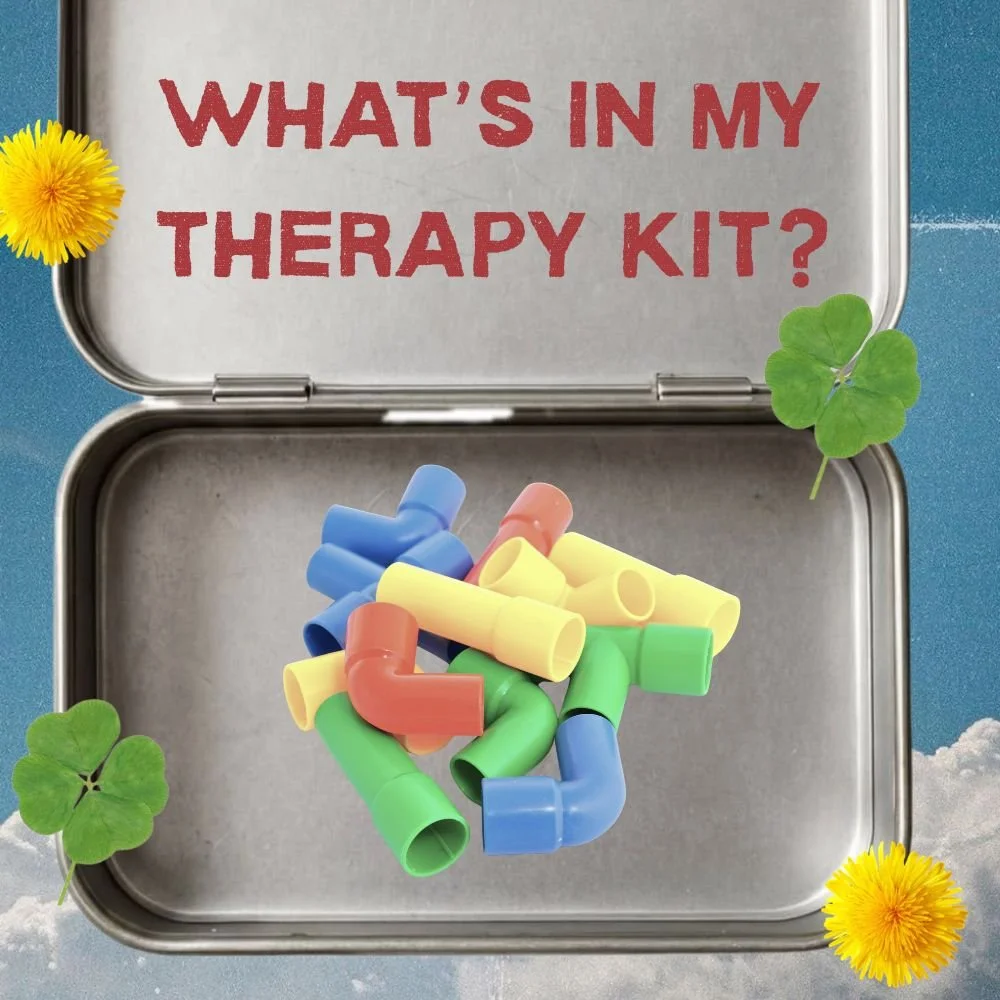
What’s in my Therapy Kit? (and it’s not what you think)
Most of my kit is loose parts. These are open-ended resources that follow the child’s lead.
I love showing the families I work with that you don’t need to buy the latest toy to capture your child’s interest. If you lean into their imagination and follow their lead, the things you already have around the house can play a perfect supporting role.

Decontextualised Language
One of the most effective ways we can support language proficiency is through the use of decontextualised language.
But what is it?
Contextualised language is talk about the here and now of it all e.g Labelling, describing, commenting on what’s happening, giving immediate directions, while decontextualised language is talk about the there and then. (Note: It’s not actually a clean split. Some language sits somewhere in between)
Why Speech Therapists love Sound Words (Onomatopoeia)
Sound words (onomatopoeia) are words that echo the sound they are referring to like, “crack,” “vroom,” “buzz,” or animal sounds like “Mooo!”
Onomatopoeia appears more often in babies' first words than other word types, and research shows they do real work for language development too.
One study found that young children's ability to recognise sound words predicted their vocabulary knowledge, even after accounting for age and other language skills.
Can Shared Book Reading be Bad?
Shared book reading is a common pastime, but if your child or isn’t into books, a focus on shared reading can actually backfire (Yiiiiiikessss!!).
Research by Kaderavek & Justice found that around 10% of children don't enjoy being read to, but this jumps to 40% for children with a language disorder.
Neurodiversity-Affirming Behaviour Support in Schools
As a speech therapist I have, before, found myself feeling frustrated when I make recommendations to schools about neurodiversity affirming approaches to behaviour but things aren’t implemented. I was sent an article in the Social Cipher newsletter the other day (would recommend this mailing list) which gave me great insight around this, and helped me think about how I can provide support to schools, and adapt to the barriers they’re facing when it comes to implementing neurodiversity affirming behaviour support.

Building Fuller Sentences
If you are looking for ways to help children explore more grammatically complex sentences, one thing is to think about where we place pronouns. Often when we talk to children, we can start with “I” or “you”, like when we say, “You’re a building tower!” or “I see the red block!”
We can try mixing up the subject position in our sentences, where instead of always using “I” and “you”, we can move objects to the front.

Reading Recommendations
A list of my recommended reading if you are interested in the relationship between natural environments and child language development.

What is True Play?
Several elements of "true play" include: being child-led, creative play, and structured.
In child-led play, as communication partners, our role is to follow and attune to what truly interests the child. It can be a significant shift for well-meaning communication partners to move from trying to introduce something they think the child would like, to instead observing what the child is naturally drawn to and exploring that with curiosity.

Why provide Speech Therapy in Nature?
Nature provides a rich environment that has positive benefits for parent-child relationships and child language development. By providing Speech and Language therapy outdoors, we harness the power of nature to support children's language and speech growth, play and relationship skills, emotional regulation, and early literacy development.
Conducting therapy in natural settings can make it easier for both the parent and child to maintain attention and take on new strategies. When outdoors, away from indoor distractions, children and parents are more likely to engage in longer, more connected conversations. This reciprocal interaction helps create strong parent-child bonds and promotes healthy brain development. Additionally, spending time in nature leads to improvements in children's mental health and emotional regulation, which is essential for successful speech and language learning.

Gentle Communication
As a speech therapist, I've often encountered children who seem to push back at every instruction or suggestion. If you're a parent, teacher, or therapist working with a child with Pathological Demand Avoidance (PDA), you might be nodding your head right now. It can be so disheartening when our sessions do not go as planned because our student is unwilling to engage. The good news? There's a communication approach that can make a world of difference: declarative language. I've recently been diving into Linda Murphy's fantastic book, "The Declarative Language Handbook," and I'm excited to share some insights with you.